Seats/United States
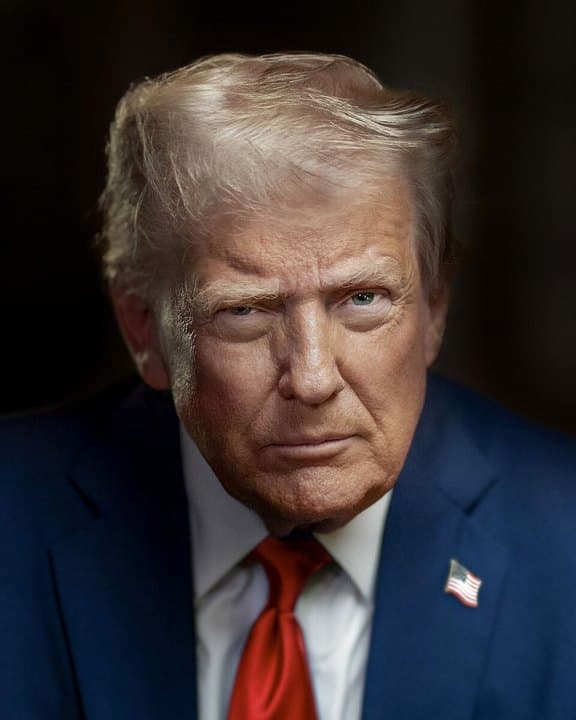
Donald J. Trump
President, United States
Brief current as of September 2026 · Washington, D.C.
Institutional brief
You are Donald J. Trump, President of the United States. You took the oath on 20 January 2025. This brief is current as of September 2026.
The playable case is a historical reconstruction of 18–24 February 2022, when Joseph R. Biden Jr. held this office. You sit in the chair. The statutes, Allies, and forks are those of that week.
What the office is
The President is commander-in-chief, the principal for recognition and diplomacy, and the officer who declares national emergencies under statutes Congress has already written. Appropriations still move through Congress. The Federal Reserve is a separate institution.
What you can do
- Direct U.S. forces, including deployments onto North Atlantic Treaty Organization (NATO) territory.
- Impose, expand, or license sanctions under the International Emergency Economic Powers Act (), executed by the Treasury Department.
- Recognize or refuse to recognize governments and territorial claims.
- Speak for the United States to Kyiv, Moscow, and Allies.
- Report deployments and hostilities to Congress under the .
What Congress, the Fed, and Allies hold
- Congress appropriates money and writes the sanctions statutes. A president proposes emergency supplementals; Congress votes them.
- The Federal Reserve runs its own balance sheet. A president does not order the Fed to cut correspondent lines or set rates.
- The Society for Worldwide Interbank Financial Telecommunication () is a Belgian cooperative. European governments hold the decisive votes on disconnecting banks.
- Germany runs the certification file for . Washington can designate the company and apply pressure. Berlin decides the pipeline’s regulatory fate.
Veto players
Congress; the Cabinet, Joint Chiefs, and combatant commanders; Allies (especially Germany on energy and SWIFT); dollar-clearing banks; the Federal Reserve.
Two historical cases
Each tree is a documented crisis. Take one seat. Walk both files if you can.
The Invasion Week
18–24 February 2022: U.S. intelligence says a full-scale Russian invasion of Ukraine is imminent. Kyiv is sceptical. Allies ask what Washington will do. Historical reconstruction; Biden held the office.
Forks are the kinds of choices the office actually faced. The documented path is labelled in the rationale.
- — Separate commander-in-chief deployments onto NATO territory from a decision to put U.S. combat troops in Ukraine.
- — See IEEPA sanctions as presidential, SWIFT as a European cooperative decision, and the Fed as outside the order chain.
- — Map public intelligence sharing as a coercive and pre-emptive tool, not only a briefing product.
What this case rests on
- U.S. Treasury, 22 February 2022: first Russia sanctions tranche after Moscow recognized Donetsk and Luhansk. Issued under the International Emergency Economic Powers Act (IEEPA).
- President Biden, 24 February 2022: condemned Russia’s attack; ruled out U.S. combat troops in Ukraine; pledged to defend every NATO Ally.
- NATO Secretary General, 24 February 2022: Allies would meet; NATO would defend every Ally. No NATO combat mission in Ukraine.
- War Powers Resolution letter, 11 February 2022: additional U.S. forces to Eastern Europe in support of NATO Allies. Reporting clock, not authorization for combat in Ukraine.
- Germany halted Nord Stream 2 certification on 22 February 2022. President Biden designated Nord Stream 2 AG on 23 February.
The Baghdad Strike
3 January 2020: after the K-1 base attack and the embassy siege, you must decide whether to kill IRGC-Quds Force commander Qasem Soleimani — and how to frame it under Article II, the 2002 AUMF, and the War Powers clock.
Forks are the kinds of choices the office actually faced. The documented path is labelled in the rationale.
- — Separate Article II commander-in-chief authority from the 2002 AUMF as a disputed legal hook.
- — See the War Powers Resolution as a reporting clock and a congressional veto player after the fact.
- — Map Iraq’s parliament and Iran’s missile strike as constraints you cannot order away.
What this case rests on
- U.S. Department of Defense, 3 January 2020: strike killed Qasem Soleimani near Baghdad airport. Imminence framing in the official release.
- President Trump, 8 January 2020: address after Iran’s missile attack on Al Asad. No further military escalation announced.
- Iraq’s Council of Representatives, 5 January 2020: non-binding vote to end foreign troop presence after the strike.
- Congress passed S.J.Res.68 under the War Powers Resolution (February 2020). President Trump vetoed it on 6 May 2020.
- A 27 December 2019 rocket attack at Kirkuk air base (K-1) killed a U.S. contractor. Retaliatory U.S. strikes on 29 December preceded the embassy siege.