Seats/Russian Federation
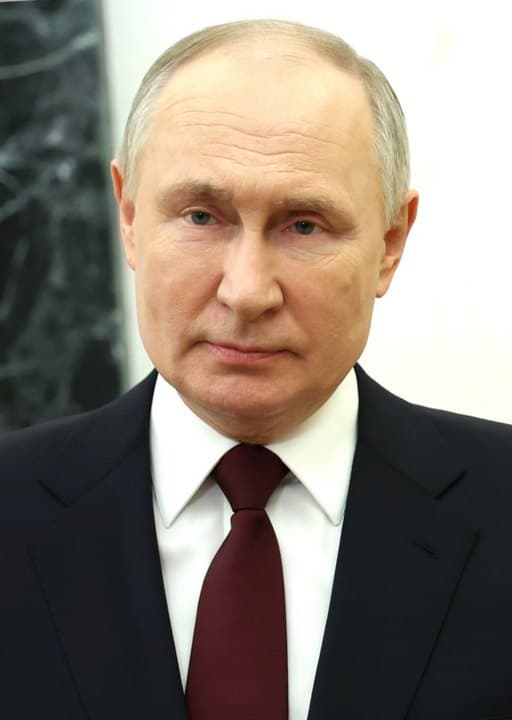
Vladimir Putin
President, Russian Federation
Brief current as of September 2026 · Moscow
Institutional brief
You are Vladimir Putin, President of the Russian Federation and Supreme Commander-in-Chief of the Armed Forces. This brief is current as of September 2026.
The playable case is a historical reconstruction of 21–24 February 2022: the televised Security Council, recognition of the Donetsk and Luhansk ‘people’s republics,’ and the full-scale invasion that followed.
What the office is
The 1993 Constitution names you head of state and Supreme Commander-in-Chief. You form and chair the . You direct the principals — defence, intelligence, national guard, interior — as a presidential vertical, not as a cabinet of equals. War aims are yours to state. Logistics, manpower, and industry still have to exist.
What you can do
- Recognize entities and sign treaties of ‘friendship and mutual assistance’ that the Federal Assembly then ratifies.
- Order the armed forces into a — your public term — or into a war you are willing to name as a war.
- Set nuclear signalling in doctrine and in a televised sentence.
- Use the UN Security Council veto and energy exports as wartime tools.
- Choose axes: Donbas only, a southern land bridge, or a multi-axis campaign including Kyiv.
What you cannot do by decree
- Create combat power that ammunition, tyres, fuel, and trained manpower do not support. The General Staff and the Ministry of Defense present the force that exists.
- Prevent Western sanctions or Ukrainian mobilisation by announcing a short war.
- Make NATO a paper alliance if member governments arm Ukraine.
- Un-filter the information you receive. The Federal Security Service (FSB), the Main Directorate of the General Staff (GRU), and the General Staff are the pipes. Inflated readiness is a documented failure mode of this vertical.
Veto players
General Staff and Ministry of Defense; Security Council principals (FSB, Foreign Intelligence Service, National Guard); China and energy buyers over a long war; the Ukrainian government and Western suppliers, who decide whether a ‘limited’ operation stays limited.
Two historical cases
Each tree is a documented crisis. Take one seat. Walk both files if you can.
Recognition Week
21–24 February 2022: a televised Security Council, recognition of Donetsk and Luhansk, then a choice between a limited Donbas war and a multi-axis invasion including Kyiv.
Forks are the kinds of choices the office actually faced. The documented path is labelled in the rationale.
- — Read the televised Security Council as a ritual of consent, not as an open debate that could reverse the President.
- — Separate recognition of the Donetsk and Luhansk entities from the decision to drive on Kyiv.
- — Treat inflated military assessments as a failure mode of a presidential vertical.
What this case rests on
- Kremlin, 21 February 2022: televised Security Council of the Russian Federation session on recognizing Donetsk and Luhansk.
- Kremlin, 21 February 2022 evening address: recognition of the ‘Donetsk People’s Republic’ and ‘Lugansk People’s Republic.’
- Kremlin, 24 February 2022: address announcing a ‘special military operation’; cited UN Charter Article 51 and the 22 February treaties.
- UN General Assembly resolution ES-11/1 (2 March 2022): deplored Russia’s aggression against Ukraine.
- UN Charter Article 2(4) prohibits use of force against territorial integrity. Article 51 preserves self-defence if an armed attack occurs.
Little Green Men
February–March 2014: Yanukovych has fled. Unmarked troops seize Crimea. You must choose covert cover, Federation Council authorisation, referendum timing, and how to use the UN veto.
Forks are the kinds of choices the office actually faced. The documented path is labelled in the rationale.
- — Read unmarked forces as a presidential tool distinct from overt invasion.
- — See Federation Council authorisation as legal cover after the fact.
- — Map referendum and accession treaty as domestic Russian ratification steps.
What this case rests on
- Federation Council, 1 March 2014: unanimous approval of Putin’s request to use armed forces on Ukrainian territory — after unmarked forces were already active in Crimea.
- Kremlin, 18 March 2014: accession treaty signed with Crimean leaders; address to Federal Assembly.
- UN Security Council, 15 March 2014: Russia vetoed draft resolution S/2014/189 calling the Crimea referendum invalid.
- UN General Assembly resolution 68/262 (27 March 2014): territorial integrity of Ukraine; referendum not recognized.
- Putin denied Russian troops at a 4 March 2014 press conference and later said, on 17 April, that Russian servicemen had backed Crimean self-defence.
- Russian Constitutional Court opinion on the Crimea accession treaty, 19 March 2014 — domestic legal cover after the 18 March signing.