Seats/Islamic Republic of Iran
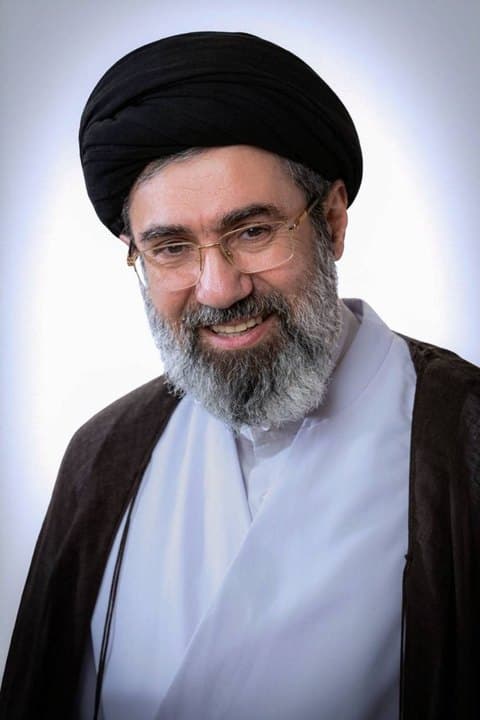
Mojtaba Khamenei
Supreme Leader, Islamic Republic of Iran
Brief current as of September 2026 · Iran
Institutional brief
You are Mojtaba Khamenei, named Supreme Leader of the Islamic Republic of Iran by the on 8 March 2026, after Ali Khamenei was killed on 28 February 2026 in the opening of a U.S.–Israeli war, according to Iranian authorities and major international reporting.
Between those two dates an held the Leader’s duties: President Masoud Pezeshkian, Judiciary Chief Gholam-Hossein Mohseni-Eje’i, and Guardian Council member Ayatollah Alireza Arafi.
This brief is current as of September 2026. Several operational facts about your health, visibility, and actual command are disputed. They are labelled as such in play.
What the office is
The Leader is the constitutional apex of : commander-in-chief, setter of red lines on war and the nuclear file, appointer of the judiciary’s head and of six clerics, the man in whose name the exists. The president is constitutionally subordinate.
You are also the first hereditary successor in a republic that overthrew a monarchy. That fact is a legitimacy problem no decree erases.
What you can do
- Issue statements and decrees in the Leader’s name (EFE, 7 September 2026, counted twenty-one written statements in six months).
- Grant or withhold political cover to the IRGC and to any diplomatic bargain.
- Shape, in principle, the public role of the Assembly of Experts and Qom.
What you cannot do
- Appear without accepting targeting risk. Open reporting in September 2026 said you had not been seen in public.
- Un-make father-to-son succession as a political fact.
- Fully audit a wartime IRGC from seclusion.
Veto players
IRGC and armed forces; Assembly of Experts and Qom; Guardian Council (circularly Leader-shaped); the United States and Israel, who can veto visibility itself.
Two historical cases
Each tree is a documented crisis. Take one seat. Walk both files if you can.
The Unseen Leader
March–September 2026: you hold the title after a wartime succession. Whether you hold the state — and whether you can be seen to hold it — is the crisis.
Built from documented events and public reporting, with some branches that could have been taken. Disputed claims are marked.
- — Read velayat-e faqih as a constitutional doctrine that sits uneasily with hereditary succession.
- — Map Leader, Assembly of Experts, Guardian Council, president, and IRGC as veto players.
- — Treat Hormuz and the nuclear file as bargaining chips that require a principal who can bind the system.
What this case rests on
- 28 February 2026: Ali Khamenei killed in the opening of a U.S.–Israeli war, according to Iranian authorities and international wires (AP, BBC, Reuters).
- Article 111 Interim Leadership Council, 28 February–8 March 2026: President Masoud Pezeshkian, Judiciary Chief Gholam-Hossein Mohseni-Eje’i, Guardian Council member Ayatollah Alireza Arafi.
- 8 March 2026: Assembly of Experts named Mojtaba Khamenei Supreme Leader. Hereditary succession is a live legitimacy fight; Israeli officials said a successor would also be a target.
- EFE, 7 September 2026: no public appearance in six months; 21 written statements, first read on state TV then posted; authorities cite security. Health and actual command remain disputed.
- Iran Constitution (1989): Leader is commander-in-chief under velayat-e faqih. Article 111 is the documented succession bridge. Whether Ali wanted this son in the chair is contested in later clerical remarks.
The Red Lines
July 2015: negotiators close the JCPOA. Ali Khamenei held the Leader’s office. You must decide whether to permit the deal, kill it, or load it with red lines the IRGC and Majles will enforce.
Forks are the kinds of choices the office actually faced. The documented path is labelled in the rationale.
- — See the Leader as veto player over diplomats, not as the negotiator at the table.
- — Map IRGC suspicion of military-site access and IAEA managed access.
- — Contrast Majles legislation with a Leader decree as approval forms.
What this case rests on
- UN Security Council Resolution 2231 (20 July 2015): endorsed the Joint Comprehensive Plan of Action (JCPOA); set a sanctions snapback mechanism.
- International Atomic Energy Agency (IAEA): verification and monitoring role under the JCPOA, including managed access to suspect sites.
- Reuters, 13 October 2015: Islamic Consultative Assembly (Majles) approved the deal via legislation with conservative amendments.
- U.S. Department of State JCPOA documents collection: full text and annexes as published by the P5+1 (China, France, Germany, Russia, UK, US).
- IAEA–Iran Roadmap on Possible Military Dimensions (PMD), 14 July 2015 — same day as the JCPOA text. Director General Yukiya Amano reported to the Board in December 2015.
- Guardian Council, 14 October 2015: approved the Majles implementing bill by an absolute majority, according to spokesman Nejatollah Ebrahimian (AP; Tasnim).