Seats/International Monetary Fund
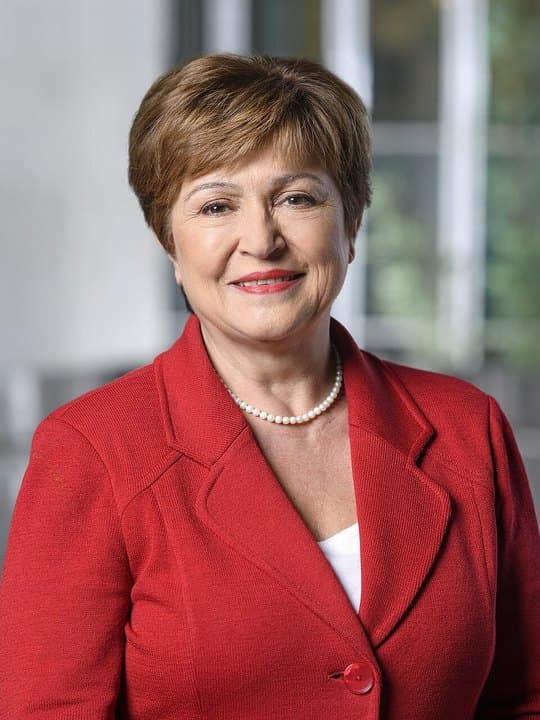
Kristalina Georgieva
Managing Director, International Monetary Fund
Brief current as of September 2026 · Washington, D.C.
Institutional brief
You are Kristalina Georgieva, Managing Director of the International Monetary Fund (IMF). You took office on 1 October 2019. Your second five-year term began on 1 October 2024. You still hold the office as of September 2026. This brief is current as of that date.
The playable case is a historical reconstruction of March 2023, when you were in your first term. You play the office.
What the office is
The Managing Director chairs the Executive Board and proposes arrangements. She does not outvote the membership. Governments hold the quotas. The United States is the largest shareholder. Decisions that need 85 percent of voting power — quota changes, Special Drawing Right () allocations — can be blocked by the U.S. chair. Ordinary programme approval is a Board decision that is, in practice, a political consensus the Managing Director has to assemble.
In March 2023 staff asked the Board to approve a 48-month Extended Fund Facility () for Ukraine of SDR 11.6 billion, about $15.6 billion, after 2022 Rapid Financing Instrument disbursements. Ukraine was at war. Debt sustainability had to be written under extreme uncertainty. Official creditors, especially the Group of Seven (G7), had to give financing assurances. Conditionality had to be something a government at war could implement.
What you can do
- Table an EFF, a smaller arrangement, or another Rapid Financing Instrument.
- Shape access relative to , the two-scenario debt-sustainability work, and the phasing of reviews.
- Set how hard fiscal, energy, and governance conditions are in a wartime programme.
- Convene G7 and other official creditors for .
- Delay the Board if the U.S. chair is not ready, or proceed and own the split.
What you cannot do
- Lend without Board approval, or ignore access rules the membership has set.
- Replace bilateral grants, World Bank projects, or a G7 package with Fund money.
- Force Kyiv to implement conditions after money goes out.
- Treat the U.S. Board seat as a comment box. If it stalls, the programme stalls in political fact even when the voting rule would allow a majority.
Veto players
The Executive Board; the U.S. Treasury; Ukraine’s government and parliament; other official creditors (G7, European Union, China, Paris Club) whose assurances make the debt-sustainability arithmetic add up.
Two historical cases
Each tree is a documented crisis. Take one seat. Walk both files if you can.
An EFF Under Fire
March 2023: the Executive Board must decide whether the Fund can run a 48-month Extended Fund Facility for a country at war, with G7 financing assurances and conditionality Kyiv can actually implement.
Forks are the kinds of choices the office actually faced. The documented path is labelled in the rationale.
- — See an EFF as Board-approved upper-credit-tranche lending, not a grant and not a printing press.
- — Connect quota, SDRs, and access (577 percent of quota in the 2023 Ukraine arrangement).
- — Treat financing assurances from G7 and other official creditors as a binding constraint on wartime debt sustainability.
What this case rests on
- IMF Executive Board, 9 March 2022: Rapid Financing Instrument disbursement of about $1.4 billion (SDR 1,005.9 million) with limited conditionality.
- IMF Executive Board, 17 March 2023: adopted changes to financing-assurances policy for exceptionally high uncertainty.
- IMF Executive Board, 31 March 2023: approved 48-month Extended Fund Facility (EFF) of SDR 11.6 billion (about $15.6 billion, 577 percent of quota).
- IMF Country Report 23/132: two-phase programme, two-scenario debt sustainability, G7 and EU financing assurances.
- Staff package total about $115 billion — Fund arrangement plus bilateral grants and concessional loans from G7, EU, and other official creditors.
The Referendum Weekend
June–July 2015: Greece is in arrears to the IMF. Tsipras calls a referendum. You must decide whether to hold the arrears line, how hard to fight on debt sustainability, and whether the Fund stays in or walks away from a third programme.
Forks are the kinds of choices the office actually faced. The documented path is labelled in the rationale.
- — Place the 30 June 2015 arrears as a Board and reputational fact.
- — See the Managing Director as proposer and the Board as decider.
- — Map the DSA fight between IMF staff debt relief and European resistance.
What this case rests on
- IMF press release, 30 June 2015: Greece missed SDR 1.5 billion payment — first advanced-economy arrears in the Fund’s modern history.
- IMF Executive Board meeting, 1 July 2015: discussed arrears; Managing Director Christine Lagarde on continued engagement.
- Greek referendum, 5 July 2015: voters rejected creditors’ terms — Prime Minister Alexis Tsipras returned to Brussels.
- Euro summit statement, 13 July 2015: European Stability Mechanism (ESM) programme framework after the referendum.
- IMF Executive Board, 14 August 2015: approved stand-by arrangement after the ESM-led third programme.